“Mandarin on the Playground”: Hongkonger’s Jolt — and a City’s Lingering Anxiety Over Its Mother Tongue
香港市民驚見小學生都講普通話,感歎廣東話危
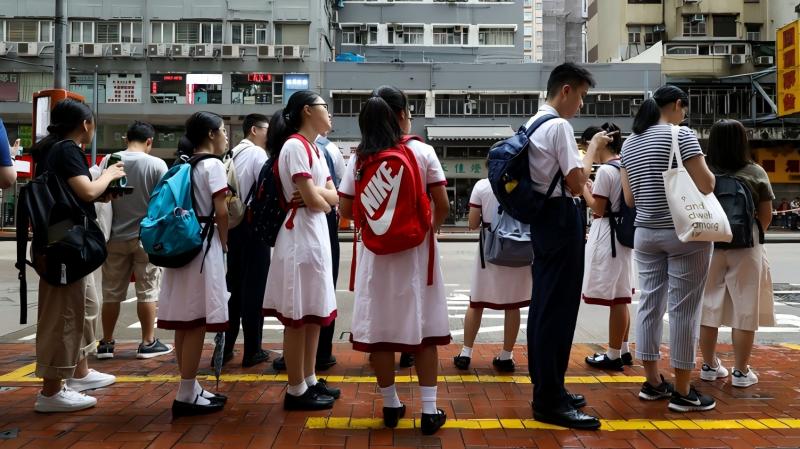
One weekend at Kowloon Tong Park, a few primary-school kids were chasing each other around the grass. What came tumbling out of their mouths wasn’t the usual “m̀h haih gáam lāa” — it was crisp, textbook Mandarin: “Bù shì zhèyàng de.” An elderly Mr. Chan, strolling behind his grandson, stopped dead in his tracks. “I nearly jumped — for a second I thought I’d wandered back across the border,” he posted on a local neighbourhood forum. Within hours, the thread had racked up hundreds of replies from people saying they’d felt the exact same thing.
Similar sightings have been piling up on Hong Kong’s social feeds lately: a parent saying they picked their kid up from school and overheard a whole cluster of pupils chatting in Mandarin; an old-timer grumbling that the schoolkids at the next table in the cha chaan teng ordered in Putonghua; a self-styled “old Hongkonger” sighing online — “Cantonese is the root of this city. Are we really going to lose it?”
The gut reaction isn’t pulled from nowhere. But the actual picture behind it is a lot more layered than the eight-character headline — “all the primary kids now speak Mandarin.”
What really changed in the classroom: two decades of “Putonghua as the medium of Chinese”
To make sense of the shock, you have to go back to 2008, when the Standing Committee on Language Education rolled out the “Putonghua as Medium of Instruction for Chinese Language” scheme — “普教中” in short. The 2015 survey told a more modest story: only about 16.4% of Hong Kong primary schools ran Chinese entirely in Mandarin, 28.3% stuck fully to Cantonese, and the rest mixed it by year or unit. In other words, “everyone speaking Mandarin” simply doesn’t describe the system-wide reality — outside the Chinese-language period, Cantonese is still the default tongue in nearly every other subject.
Why it rattles people: not just a language, but an identity
Why does a handful of kids chattering in Mandarin tighten so many chests?
Cantonese in Hong Kong was never just a communication tool. Roughly 97% of the local population still uses it day to day at home and on the street. It carries the soundtrack of Sam Hui and Leslie Cheung, the deadpan nonsense of Stephen Chow’s films, the immortal one-liners of TVB dramas, the clatter of a cha chaan teng at 8 a.m. It is the collective memory of several generations. When the ear no longer catches that texture in the next generation, the fear isn’t about pronunciation — it’s about a whole cultural register quietly slipping.
Where the real risk actually sits — not the classroom, but the everyday
Strip away the noise, and the genuine pressure points on Cantonese transmission are elsewhere:
- The home. Linguists have said it for decades — a language that loses its domestic hearth won’t survive on classroom hours alone. The saving grace: close to 97% of Hong Kong households still run on Cantonese at the dinner table. That’s the thickest cushion Cantonese has.
- Popular culture. The golden age of Cantopop is behind us; TVB’s cultural reach isn’t what it was. As the younger cohort’s entertainment migrates to Mandarin-dominant mainland short-video apps and streaming platforms, Cantonese as a carrier of cultural texture keeps getting thinned out.
- The neighbourhood micro-scene. The cha chaan teng, the wet market, the lift small-talk — these are the breathing spaces where Cantonese actually lives. If demographic shifts and a new generation’s habits erode those corners, that is when the language drifts into real danger.
The closer truth: a city that holds more than one voice
Back to Mr. Chan at Kowloon Tong Park. Those Mandarin-chattering kids he clocked? Chances are they’ll still get scolded in Cantonese the moment they walk through the door — “faai dī jouh gūng fo!” They’ll still sit in weekend Cantonese opera classes, still lean over the counter at the corner café and call out “sī māah nàaih chàh — m̀h gōi!”
Hong Kong’s whole distinctiveness has always been this: one person carrying several linguistic identities at once — Cantonese as the root, Putonghua as the bridge, English as the window. Worrying about Cantonese fading is fair. But blowing up a few schools, a few scattered sightings into a full-blown “Cantonese is finished” verdict is neither accurate nor useful — and it buries the real question:
The real question was never “should primary kids be allowed to speak Mandarin,” but whether Hong Kong can, while promoting the national common language, deliberately keep carving out room for Cantonese to stay alive — let the Cantopop keep getting written, let the local films keep getting shot, let the “m̀h gōi” and “dō jeh” keep ringing across the booth at the tea café.
A language’s vitality was never in a Bureau circular. It lives or dies in whether ordinary people, at the next unguarded moment of the day, still let that one unmistakably Cantonese line slip off the tongue.
Sources noted: Hong Kong’s “普教中” scheme launched 2008; 2015 SCOLAR survey — 16.4% primary schools full Mandarin-medium for Chinese, 28.3% full Cantonese-medium; Bureau itself conceded no conclusive evidence that Putonghua-medium raises Chinese attainment; ~97% of Hong Kong residents use Cantonese for daily communication; 2026 hotel-group remarks on shifting to Mandarin as primary instructional language reignited the same public flare-up.
Want me to tighten this into a punchier ~500-word op-ed cut, or keep a version that leans more deliberately into the South China Morning Post house style? Either way I can also drop in a short standfirst + headline pair if you’re placing it somewhere.
週末嘅九龍塘公園,幾個著住小學校服嘅細路追追逐逐,衝口而出嘅唔係「唔係咁啦」,而係一口字正腔圓嘅「不是這樣的」——呢一幕搞到陪住孫仔散步嘅陳伯停低咗腳步。「我嚇咗一跳,以為自己返咗內地。」佢喺社區論壇寫低呢句感受,短時間內引嚟幾百個人共鳴。
類似嘅觀察近期喺香港社交媒體不斷出現:有家長話,去學校接細路,聽到成群小學生用普通話傾偈;有老人家投訴,茶餐廳入面隔離枱嘅學童點餐用普通話;更有自稱「老香港」嘅網民感嘆:「粵語係香港嘅根,難道要冇咗?」
市民嘅直覺唔係空穴來風,但背後嘅真實情況,遠比「小學生全部講普通話」呢八個字複雜。
課堂入面嘅變化:普教中二十年
要理解市民嘅「驚見」,要返去2008年。嗰年語常會推出「普教中」計劃。根據2015年嘅調查,香港小學入面全面用普通話教中文科嘅比例大約16.4%,全面用廣東話嘅有28.3%,其餘係混合安排。換句話講,「全部講普通話」並唔符合香港小學嘅整體現實——至少喺中文堂以外,粵語仍然係絕大部分學校其他科目嘅教學語言。
市民嘅擔憂:唔單止係語言,係身份
點解一句「小學生講普通話」會搞到好多香港人心裡面緊張?
粵語喺香港從來唔單止係溝通工具。全港大約97%嘅本地人口以廣東話做日常交際語言。從許冠傑、張國榮嘅金曲,到周星馳電影嘅無厘頭對白,從TVB劇集嘅經典對白到茶餐廳嘅繁忙朝早,粵語承載住香港幾代人嘅集體回憶。
真正嘅危機唔喺課堂,而係喺日常生活
如果撥開輿論嘅迷霧,粵語傳承嘅真正風險喺邊度?
第一,喺家庭。語言學家早就指出,一種語言如果脫離日常家庭使用,淨係靠課堂維持係遠遠唔夠嘅。好彩而家香港接近97%家庭仍然用粵語日常交流,呢個係粵語最厚嘅緩衝墊。
第二,喺流行文化。粵語流行曲嘅黃金時代已經過咗,TVB劇集嘅影響力都唔及當年。當年輕一代嘅娛樂消費轉向普通話內容為主嘅內地短影片同埋串流平台,粵語作為「文化載體」嘅功能正在被稀釋。
第三,喺社區場景。茶餐廳、街市、鄰裏閒聊——呢啲粵語賴以生存嘅「微環境」如果因為人口結構變化同埋新一代語言習慣而改變,粵語先至會真正走入危險區。
真正嘅問題唔係「小學生該唔該講普通話」,而係香港社會能唔能夠主動為粵語創造更多使用場景——等粵語流行曲繼續唱落去,等粵語電影繼續拍落去,等茶餐廳入面嘅「唔該」同埋「多謝」繼續響落去。
語言嘅生命力,從來唔喺教育局嘅文件入面,而係喺普通人願唔願意喺下一個日常瞬間,衝口而出嗰句「地道粵語」。