The “Cantonese Ban” Controversy at a Hong Kong School’s Graduation Video: A Trust Crisis Sparked by a “Draft”
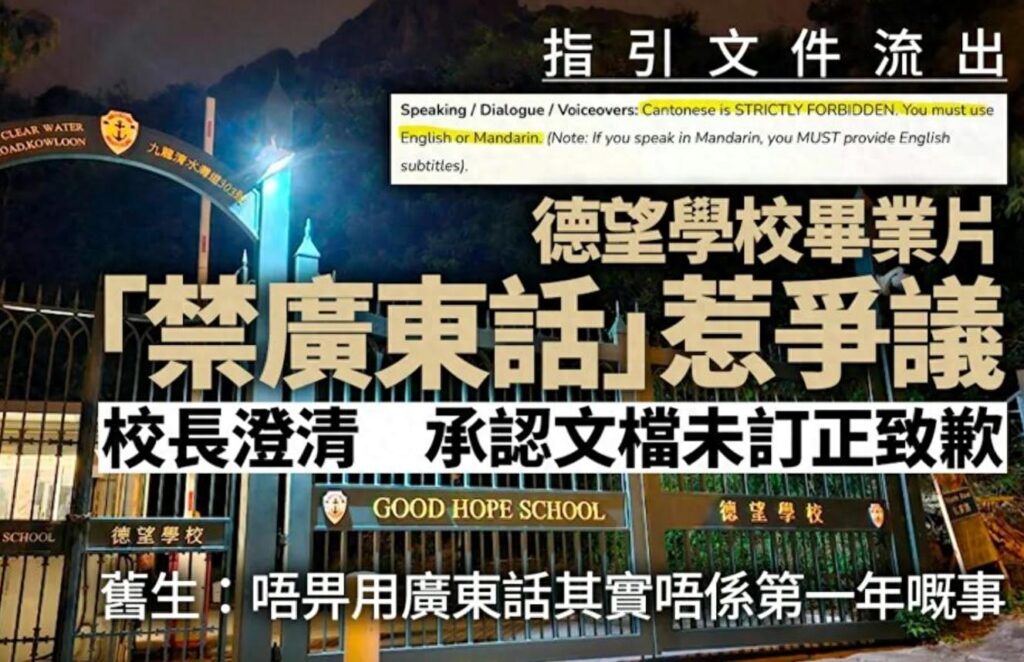
香港老牌直資女校德望學校禁講廣東話
A graduation guideline has struck a nerve in Hong Kong society regarding language issues.
Recently, Good Hope School, a long-established Direct Subsidy Scheme (DSS) girls’ school in Hong Kong, has found itself in a whirlwind of public controversy. A leaked production guide for the F.6 graduation farewell video circulating online boldly stated in red text that Cantonese is a “strictly prohibited language.” The document stipulated that if Cantonese dialogue or narration is detected in the video, the relevant segments would be directly muted, and students would be required to remake the video. Even students expressing gratitude to their Chinese language teachers were required to use Mandarin (Putonghua).
This extremely strict, almost absurd regulation quickly went viral on social media platforms. Many current students and alumni openly said it was “unacceptable” — a graduation video is supposed to be a precious keepsake documenting six years of school life. Is it reasonable to not even allow students the space to say “thank you” in their mother tongue? Some pointed out that this is not a new rule introduced this year. Former students revealed that similar language restrictions have existed in previous years and are not accidental oversights.
Principal’s Emergency Response: “It’s a Draft, I Take Full Responsibility”
As the incident continued to escalate, Gary Harfitt, the principal of Good Hope School, sent an email to all teachers, students, and parents overnight, attempting to defuse the situation. In his email, he explained that the leaked document was merely a draft that had not undergone the school’s final review. The inappropriate wording in the text does not represent the school’s official policy. The school has never implemented a rule banning Cantonese. He is willing to take full responsibility for the erroneous document being sent to F.6 students and will communicate specifically with the graduating class.
Netizens Aren’t Buying It: “A Complete PPT Was Sent Out, and You Call It a Draft?”
However, the principal’s clarification did not quell the doubts. Many netizens pointed out that this document was already made into a complete PPT presentation and formally distributed to all F.6 students, complete with a full penalty chain of “detection — muting — remaking.” Such specific execution rules are hard to explain away with a simple phrase like “uncorrected draft.” Many believe this is more like a crisis PR tactic, attempting to shift the blame onto a “draft” to mitigate the negative impact. The Hong Kong Education Bureau has also confirmed its attention to this matter, stating that it has received relevant information and urged the school to re-examine the arrangements regarding the graduation video.
Behind the Controversy: The Misinterpreted “Bilingualism and Trilingualism”
The core of this storm has long surpassed the language choice in a graduation video, pointing directly to the misunderstanding of the “Bilingualism and Trilingualism” policy within Hong Kong’s education sector. Hong Kong promotes “Bilingualism and Trilingualism” (written Chinese and English; spoken Mandarin, Cantonese, and English). The original intention was to cultivate multilingual abilities, not to use one language to squeeze out another. Some commentators pointed out that this incident reflects an excessive self-censorship mentality among certain education administrators — wrongly equating “promoting Mandarin” and “English learning” with “restricting Cantonese.” Cantonese is the mother tongue used by generations in Hong Kong, carrying the emotional memories and cultural identity of local students. The core value of a graduation video lies in recording youth and preserving memories. Students thanking their teachers in the most familiar and natural mother tongue is itself an embodiment of educational humanistic care. Imposing hard restrictions or even “muting” penalties undoubtedly deviates from the original intention of education.
Another Voice: Don’t Rush to Judgment
However, there are also different rational voices in the public opinion field. Some netizens familiar with Good Hope School explained that the school itself is an English-medium secondary school. Except for Chinese language classes, all other subjects are taught in English. In the daily school environment, student communication is mostly in Cantonese mixed with English, and the school has never banned Cantonese in daily settings. Netizens holding this view speculate that the original intention of the guideline was most likely to hope that the graduation video would be recorded in English, so that it could be used as external promotional material for the school to showcase students’ English proficiency — rather than to “completely eliminate Cantonese.” In reality, even if students used Cantonese in the video, the school did not actually implement criticism or editing. Some netizens reminded that once the incident is simplified into a narrative of “suppressing Cantonese and forcibly promoting Mandarin,” it is easily subject to one-sided interpretation or even exploited by those with ulterior motives to amplify social conflicts. Following the trend to make judgments or gain traffic without fully understanding the background does not help solve the problem.
Reflection: Language Learning is Not a “Zero-Sum Game”
The two voices continue to collide online, and this storm itself has sounded an alarm for Hong Kong’s education sector. When organizing campus activities, schools should accurately grasp the core spirit of “Bilingualism and Trilingualism” — multicultural tolerance, rather than an either-or approach. There is no need for Cantonese, Mandarin, and English to exclude each other. Truly high-quality language education allows students to switch freely among the three languages, rather than using rules to push one language to the margins.
近日,香港老牌直資女校德望學校(Good Hope School)陷入輿論漩渦。網上流傳的一份中六畢業告别影片制作指引中,赫然用紅字标注:廣東話屬于”嚴格禁止使用”的語言。文件規定,一旦影片檢測到廣東話對白或旁白,相關片段将被直接靜音,學生必須重新制作。
甚至連學生向中文老師表達感謝,都被要求必須使用普通話。
這份嚴苛到近乎荒誕的規定,在社交平台迅速發酵。不少在校生和校友直言”難以接受”——畢業影片本是記錄六年校園時光的珍貴載體,連用自己的母語講一句”謝謝”的空間都不給,是否合理?
更有人指出,這并非今年才有的新規定。有舊生透露,類似的語言限制往年就已存在,并非偶然失誤。
校長緊急滅火:”是草稿,我擔責”
事件持續升溫後,德望學校校長Gary Harfitt連夜向全校師生及家長發送郵件,試圖為風波降溫。
他在郵件中解釋:流出的文件隻是一份未經校方最終審核的草稿,文中存在不合适的表述,并不代表學校正式政策。校方從未出台禁止廣東話的規定,對于錯誤文稿被發送給中六學生,他願意承擔全部責任,并将與畢業班學生專門溝通。
網友不買賬:”完整PPT都發了,講是草稿?”
然而,校長的澄清并未平息質疑。
不少網友指出,這份文件已做成完整的PPT簡報,正式下發給全體中六學生,且附帶了”檢測—靜音—重制”的完整處罰鏈條。如此具體的執行規則,很難用一句”未訂正草稿”來解釋。許多人認為,這更像是一次危機公關話術,試圖将責任推給一份”草稿”來降低負面影響。
香港教育局也已确認關注此事,表示已收到相關信息,并督促學校重新審視畢業影片的相關安排。
争議背後:被誤讀的”兩文三語”
這場風波的核心,早已超越一段畢業視頻的語言選擇,直指香港教育界對”兩文三語”政策的理解偏差。
香港推行”兩文三語”(中文、英文書面,普通話、廣東話、英語口頭),本意是培養多元語言能力,而非用一種語言擠壓另一種。有評論指出,此次事件折射出個别教育管理者存在過度自我審查的心态——将”推廣普通話”和”英語學習”錯誤地等同于”限制廣東話”。
廣東話是香港世代使用的母語,承載着本地學生的情感記憶與文化認同。畢業影片的核心價值在于記錄青春、留存回憶,學生用最熟悉、最自然的母語向老師緻謝,本身就是教育人文關懷的體現。若以硬性規則設限甚至施以”靜音”處罰,無疑背離了教育的初衷。
另一種聲音:别急着定性
不過,輿論場中也存在不同的理性聲音。
有熟悉德望學校的網友介紹,該校本身是一所英文授課中學,除中文課外,其餘學科全部使用英語教學。校内日常環境中,學生交流多以廣東話搭配英語為主,學校從未在日常場景中禁止廣東話。
持此觀點的網友推測,該指引的初衷大概率是希望畢業影片采用英文錄制,以便後續作為學校對外宣傳素材,展示學生英文水平——而非要”全面消滅廣東話”。現實中,即便學生在視頻中使用了廣東話,學校也并未實際執行批評或删減。
有網友提醒,事件被簡化為”打壓廣東話、強制推普”的叙事後,容易被片面解讀甚至被别有用心者利用,放大社會矛盾。在没有完整了解背景前,跟風定性、博取流量,無助于問題解決。
反思:語言學習不是”零和遊戲”
兩種聲音在網絡上持續碰撞,而這起風波本身,已為香港教育界敲響警鍾。
學校在組織校園活動時,應準确把握”兩文三語”的核心精神——多元包容,而非非此即彼。廣東話、普通話、英語之間,本不需要互相排斥。真正優質的語言教育,是讓學生在三種語言間自如切换,而非用規則将某一種語言推向邊緣。